Walk into any supermarket or open any beauty app in India today, and you will notice something. Bar soaps still fill the shelves, but the bottles next to them are growing fast. Body wash is no longer a “premium extra” that only a few people buy. It has become a normal part of daily bathing for millions of Indians, especially in cities.
This shift is good news if you are thinking of starting your own personal care brand. But building a body wash line from scratch, buying machines, hiring chemists, setting up a factory, is slow, costly, and risky. This is exactly why more and more founders are choosing private label body wash manufacturing instead.
What Does Private Label Body Wash Manufacturing Mean?
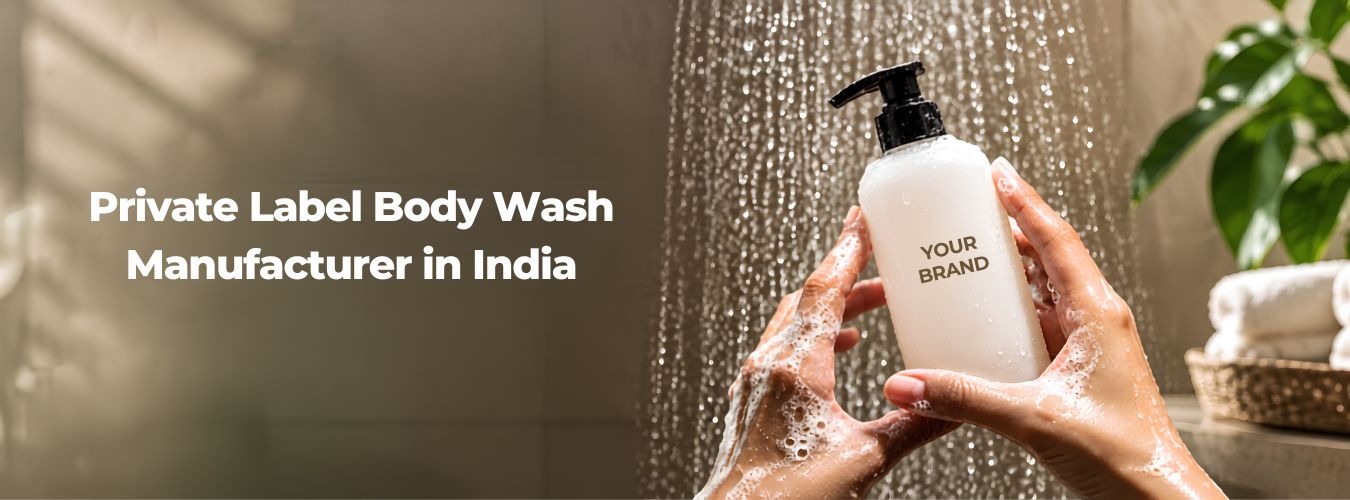
Private label manufacturing simply means a factory makes the product, and you sell it under your own brand name. You do not need your own production unit. You do not need to hire scientists. You do not need to buy raw materials in bulk.
You choose a formula (or ask for a custom one), pick your bottle, design your label, and the manufacturer handles production, testing, and packaging. The final product reaches you ready to sell, with your brand name on it, not the factory’s name.
This model is common across skincare, haircare, and body care in India today, and body wash is one of the fastest-growing categories within it.
Why Body Wash Is a Smart Category to Enter Right Now
Let’s look at what is actually happening in the market, based on real industry data.
The Market Is Growing Fast
India’s bath and shower category, which includes soaps, body wash, and shower gels, recorded retail sales of around INR 353.7 billion in 2025, growing at a steady pace, supported by a population of over 1.46 billion people and rising household spending power.
Within this larger category, body wash and shower gel specifically are the fastest-moving part. One industry report values the India body wash and shower gel market at around USD 1,283.79 million in 2024, with an expected growth rate of about 9.7% every year going forward. Another report puts the wider bath and shower products market at USD 2.92 billion in 2024, projected to reach USD 4.58 billion by 2030, growing at nearly 7.79% a year.
Consumers Are Moving From Bar Soap to Liquid Body Wash
For years, bar soap was the default choice in Indian households. That is changing quickly. Market data shows that liquid body wash has grown from holding roughly 15 to 18% of the personal wash category by value five years ago to around 28 to 32% today, even though it is still a smaller share by volume. In simple words, people are buying fewer bars and more bottles, and they are willing to pay more per bottle for a better bathing experience.
This same report notes that private label penetration in body wash is still small, only around 3 to 5% of total market value, but it is expanding through large retail chains and online platforms. That is a meaningful signal. It means the private label opportunity in body wash is still fresh and has real room to grow, unlike more saturated categories.
Refill Packs and Sustainable Formats Are Rising Fast
Another interesting trend is the shift toward refill packs. The India body wash refill segment is growing at an estimated 14 to 20% volume growth rate between 2026 and 2035, which is much faster than the main body wash category. Within this, natural and ayurvedic refill formats are growing even faster, at around 20 to 28% a year, driven by consumers who care about both their skin and the environment.
Men’s Grooming Is Adding New Buyers
Body wash is also gaining ground because more men are now buying grooming products for themselves. Industry research points to the growing men’s grooming segment in India as one of the key reasons body wash demand is expected to grow at a CAGR of around 8.7 to 8.84% between 2025 and 2030.
Put together, this data tells a clear story. Body wash is one of the few personal care categories in India that is growing quickly, still has low private label competition, and has multiple sub-trends, refill packs, natural formulas, and men’s grooming, that a new brand can build around.
What Makes a Body Wash Product Successful Today
Consumers today are more careful about what they put on their skin than they were even a few years ago. Based on current trends, a few things stand out.
Gentle, skin-friendly cleansing: Buyers want a wash that cleans well without leaving skin dry or tight. This has pushed many brands toward mild, sulfate-free, or low-sulfate formulas.
Added skin benefits: Plain cleansing is no longer enough. Moisturising ingredients like shea butter, glycerin, and natural oils, along with skin-specific formulas for dry skin, oily skin, or sensitive skin, are now common expectations.
Pleasant, long-lasting fragrance: Scent plays a big role in why people repurchase a body wash. Long-lasting, well-balanced fragrances are a major selling point.
Natural and ayurvedic positioning: Ingredients like aloe vera, neem, turmeric, rose, and charcoal are trusted by Indian consumers and perform well both online and offline.
Better packaging and formats: Pump bottles, travel sizes, and refill pouches are becoming popular, especially with online shoppers who value convenience and less plastic waste.
A private label manufacturer with strong formulation experience can help you build a product around these expectations, without you needing any technical background yourself.
How the Private Label Body Wash Process Actually Works
Here is a simple breakdown of what usually happens when you decide to launch a private label body wash range.
Step 1: Share Your Idea
You start by telling the manufacturer what kind of body wash you want. This includes your target audience, your budget, the skin benefit you want to highlight, and your preferred fragrance style or ingredients. If you are unsure, a good manufacturer will guide you based on current market trends.
Step 2: Formula Selection or Custom Formulation
You can either choose from the manufacturer’s existing, ready-to-use formulas, which is faster and more affordable, or request a fully custom formulation built around your specific requirements. Custom formulation takes longer but gives you a more unique product.
Step 3: Sampling
The manufacturer prepares a sample batch for you to test. This is your chance to check the texture, lather, fragrance, and overall feel of the product, and request changes if needed. Most brands go through two to three rounds of sampling before finalising a formula.
Step 4: Packaging and Branding
Once the formula is locked, you choose your bottle design, cap style, and label. This is where your brand identity comes to life, your logo, colours, and product name are printed on packaging that suits your target customer.
Step 5: Compliance and Testing
This is one of the most important, and often overlooked, parts of the process. Every cosmetic product sold in India needs to follow the rules laid out under the Cosmetics Rules, 2020, managed by the Central Drugs Standard Control Organization (CDSCO) and the Bureau of Indian Standards (BIS).
If you are working with a third-party manufacturer, in most cases you will need a loan license, which allows you to legally sell a product made in someone else’s certified facility under your own brand name. A trustworthy manufacturer will already hold the required manufacturing license (COS-8), along with Good Manufacturing Practice (GMP) compliance, and ideally international standards like ISO 22716, which is the global benchmark for cosmetic manufacturing hygiene and quality.
Working with a manufacturer who already holds these certifications saves you significant time, cost, and legal risk.
Step 6: Production and Delivery
Once everything is approved, the manufacturer produces your order in bulk, packs it, and ships it to you or directly to your warehouse or fulfilment partner, ready for sale.
Common Mistakes New Brands Should Avoid
Choosing the cheapest manufacturer without checking certifications. A low price is tempting, but if the manufacturer does not hold a valid GMP or manufacturing license, you could face compliance issues later, including product recalls or legal trouble.
Skipping the sampling stage: Approving a formula without properly testing it on real skin, over a few days, can lead to costly reformulation after the product is already in the market.
Ignoring packaging trends: A great formula in outdated or unattractive packaging will struggle to sell, especially online, where the bottle photo is often the first thing a customer sees.
Not planning for repeat purchase: Body wash is a repeat-purchase category. Building a formula and fragrance experience that customers want to buy again is more important than a flashy one-time launch.
Why Private Label Makes Sense for Body Wash Specifically
Setting up your own cosmetic manufacturing unit in India requires machinery, a certified facility, trained technical staff, and ongoing compliance work, an investment that can take months, if not years, to set up properly. Private label manufacturing removes almost all of that burden.
You get access to an already-certified facility, experienced formulators, and a tested production process, while you focus on what actually grows a brand: your positioning, your marketing, and your customer relationships.
Given that body wash in India is growing at close to 8 to 10% a year, private label penetration is still low, and consumer preferences are shifting toward better formulas and better packaging, this is a strong window of time to enter the category with a well-made, well-branded product.
Conclusion
Body wash is quietly becoming one of the strongest growth categories in Indian personal care. The shift from bar soap to liquid formats, rising demand for skin-friendly and natural formulas, growing interest in refill packs, and the expanding men’s grooming market are all pointing in the same direction: this is a good time to launch.
Private label manufacturing makes it possible to enter this space without the cost and complexity of building your own factory, while still delivering a high-quality, compliant, and well-branded product to your customers.
Ready to launch your own body wash brand? The Rich Daddy International offers complete private label and OEM/ODM body care manufacturing in India, from formulation and sampling to packaging and delivery. Get in touch with our team to start building your body wash range today.