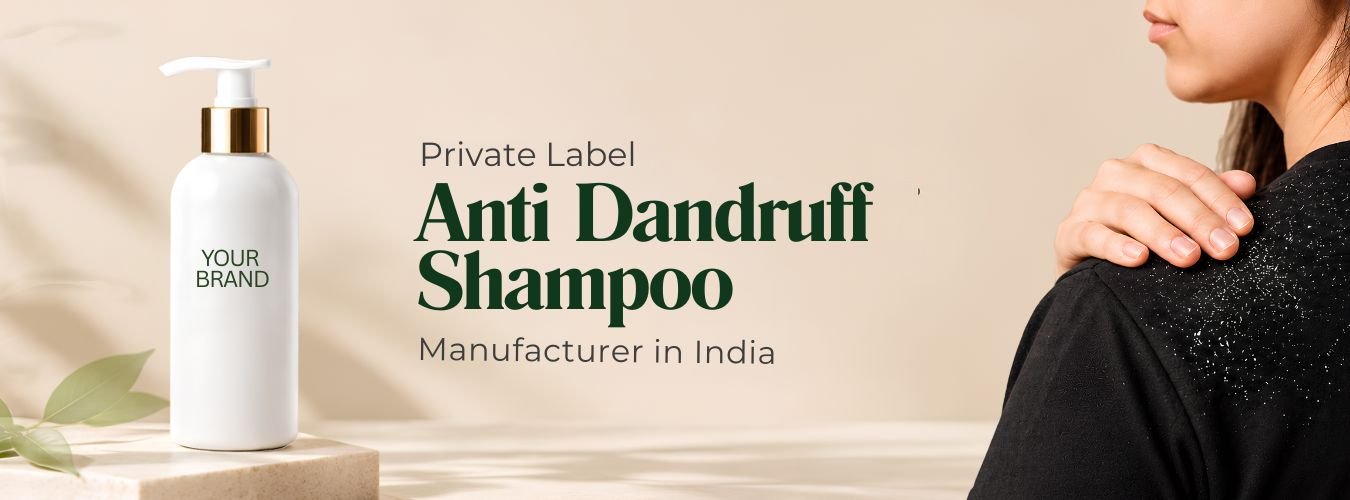
Dandruff is one of the most common scalp problems in India. It affects people of all ages and can cause itching, flaking, and embarrassment. The good news is that the demand for effective anti dandruff shampoos is growing, and this creates a strong opportunity for brands looking to enter the hair care market.
According to health data, dandruff affects nearly 50% of adults worldwide. In India, the number is even higher, with up to 70% of the population experiencing dandruff at some point. This high prevalence means that millions of people are actively looking for solutions.
For entrepreneurs and established brands, private label manufacturing offers a practical way to launch an anti dandruff shampoo without building a factory. In this blog, we will explore the market, the key ingredients, the regulations, and how to choose the right manufacturing partner.
The Growing Market for Anti Dandruff Shampoos in India
Market Size and Growth
The global anti dandruff shampoo market is growing steadily. According to market research, the global market is estimated at USD 8.2 billion in 2026 and is projected to reach USD 15.8 billion by 2036, growing at a compound annual growth rate of 7.6%.
India is a standout market within this space. The same report projects India to show the highest regional growth rate at 8.5% during the forecast period. This growth is driven by increasing awareness about personal grooming, growing disposable incomes, and the high prevalence of dandruff-related issues in the country.
The scalp care market in India also shows strong fundamentals. Treatment shampoos and conditioners dominate demand, representing 55-60% of market volume. Within this, anti-dandruff and anti-hair fall claims account for 80% of product choices at the SKU level. This tells us that consumers are actively seeking out products that address their specific scalp concerns.
Why Consumers Are Buying More Anti Dandruff Shampoos
Several factors are driving this demand. First, there is greater awareness. People now understand that dandruff is not just a cosmetic issue but a scalp health concern that can be treated. Second, the availability of medicated and specialty shampoos has increased. Consumers can choose from a wide range of products at different price points.
Third, the e-commerce boom has made it easier for consumers to research and buy products. Online platforms and quick-commerce apps now account for an estimated 25-30% of scalp care sales value, with a higher share for premium products. This makes it easier for new brands to reach customers directly.
Understanding Dandruff and How Anti Dandruff Shampoos Work
What Causes Dandruff?
Dandruff is primarily caused by a yeast-like fungus called Malassezia that lives on the scalp. When this fungus grows too quickly, it can cause the scalp to become irritated and produce extra skin cells, which then shed as flakes. Other factors like dry skin, stress, and poor hygiene can make the problem worse.
The goal of an anti dandruff shampoo is to control the growth of this fungus, reduce inflammation, and help the scalp return to a healthy state.
Key Active Ingredients in Anti Dandruff Shampoos
Understanding the active ingredients is essential for anyone developing a product. Here are the most common ones used in modern formulations.
Zinc Pyrithione (ZPT) is one of the most widely used anti-dandruff agents. It helps prevent itching and flaking. A meta-analysis of 17 clinical studies confirmed the effectiveness of 1% Zinc Pyrithione shampoos in improving dandruff in both male and female Asian subjects.
Ketoconazole is a broad-spectrum antifungal agent. Clinical research shows that 1% ketoconazole shampoo is effective in controlling dandruff and reducing hair shedding. In a study of 150 men, ketoconazole reduced hair shedding by 17.3% and increased hair shaft diameter by 5.4%.
Selenium Sulfide is another effective antifungal agent. A double-blind study comparing 1% selenium disulfide with 1% zinc pyrithione found that selenium disulfide showed superior improvement in key parameters. Symptom scores decreased by 74.6% with selenium disulfide compared to 68.7% with zinc pyrithione after four weeks.
Piroctone Olamine is a newer antifungal agent that also helps control dandruff. The same study that tested ketoconazole found that 1% piroctone olamine reduced hair shedding by 16.5% and increased hair shaft diameter by 7.7%.
Salicylic Acid is a keratolytic agent. It helps shed dead skin cells from the scalp, making it easier to remove flakes. It is often combined with other anti-dandruff ingredients.
Why Choose Private Label Manufacturing for Your Anti Dandruff Shampoo
What is Private Label Manufacturing?
Private label manufacturing means that a manufacturer produces products that are sold under your brand name. You choose the formulation, the packaging, and the branding. The manufacturer handles the production.
This is different from buying a ready-made product from a distributor. With private label, you have control over what goes into your product and how it is presented to customers. You also build your own brand equity rather than promoting someone else’s product.
The Benefits for Your Brand
There are several advantages to private label manufacturing for anti dandruff shampoo.
Full Brand Control: You decide on the active ingredients, the fragrance, the texture, and the packaging. This allows you to create a product that matches your brand’s positioning and appeals to your target audience.
Better Profit Margins: Since your product is unique, you can set your own pricing. You are not competing solely on price with identical products from other brands.
Faster Time to Market: While there is development work involved, private label is much faster than building your own manufacturing facility. You can leverage the manufacturer’s existing infrastructure and expertise.
Regulatory Support: A good manufacturer will understand the regulatory requirements for cosmetic products in India and can help you meet them.
Regulatory Requirements for Anti Dandruff Shampoo Manufacturing in India
Cosmetics Rules, 2020
Anti dandruff shampoo is classified as a cosmetic product in India, and its manufacturing is governed by the Cosmetics Rules, 2020, under the Drugs and Cosmetics Act, 1940. To manufacture cosmetics for sale or distribution, you need a manufacturing license from the State Licensing Authority.
For a standard manufacturing license, the form is COS-8. If you are using a third-party manufacturer’s facility, a loan license in Form COS-9 is required.
Key Compliance Points
The manufacturer must follow Good Manufacturing Practices as specified in the rules. This includes requirements for premises, equipment, quality control, and documentation.
The product must meet the standards set by the Bureau of Indian Standards. For shampoo, the relevant standard is IS 7884. This standard covers pH levels, foam height, and active detergent content.
Labeling is also regulated. The label must include the product name, ingredient list, net quantity, manufacturing date, expiry date, and manufacturer information. For anti dandruff shampoos, any claims made on the label must be substantiated.
What to Look for in a Private Label Anti Dandruff Shampoo Manufacturer
Manufacturing Capabilities and Quality Control
The manufacturer you choose should have a proper facility with the right equipment for making shampoo. They should follow Good Manufacturing Practices and have a system for quality control.
Ask about their testing processes. Do they test for pH, viscosity, and microbial safety? Do they keep batch records and retain samples? A manufacturer with GMP certification and ISO 9001:2015 certification is a good sign.
Formulation Expertise
Anti dandruff shampoos require careful formulation. The active ingredients must be stable, effective, and safe. The manufacturer should have a research and development team that understands how to combine anti-dandruff agents with cleansing surfactants and conditioning agents.
Look for a manufacturer with experience in hair care products. They should be able to advise you on the right concentration of active ingredients and help you create a product that delivers results.
Custom Formulation Support
If you want a unique product, look for a manufacturer who offers custom formulation. They should be able to work with you to develop a shampoo that matches your specific requirements.
This might include using particular active ingredients, creating a specific fragrance, or developing a product for a particular hair type or scalp condition.
Packaging Options
The right packaging makes a difference. A good manufacturer will offer a range of packaging options, including bottles of different sizes and types. They should also be able to help you with labeling and design compliance.
Scalability
As your brand grows, you need a manufacturer who can scale up production to meet your demand. Ask about their production capacity and their ability to handle larger orders over time. A manufacturer with flexible batch sizes is ideal for startups and growing brands.
Market Opportunities for Your Anti Dandruff Shampoo Brand
Natural and Herbal Formulations
There is growing interest in natural and herbal anti dandruff shampoos. Ingredients like tea tree oil, neem, aloe vera, and bhringraj are popular with consumers who prefer plant-based solutions. A manufacturer who can incorporate these ingredients into effective formulations can help you tap into this trend.
Medicated and Clinical Options
Some consumers need stronger solutions for persistent dandruff. Medicated shampoos with ingredients like ketoconazole or selenium sulfide are available over the counter and are in steady demand. This segment is less sensitive to price and more dependent on proven results.
Men’s Grooming
The men’s grooming market is growing rapidly in India. Anti dandruff shampoos designed specifically for men, with appropriate fragrances and packaging, represent an underserved segment. Research shows that males may be more prone to dandruff due to lower ceramide levels in the scalp, making them a key target market.
E-commerce and D2C Brands
The growth of online shopping has made it easier for new brands to reach customers. Direct-to-consumer brands can build a following through social media and targeted marketing. A private label manufacturer with low minimum order quantities can help you test the market before scaling up.
Conclusion
The anti dandruff shampoo market in India is large and growing. With high dandruff prevalence and increasing consumer awareness, there is strong demand for effective products. Private label manufacturing offers a practical path to launch your own brand without the need for your own factory.
The key is to choose the right manufacturing partner. Look for a manufacturer with proven formulation expertise, quality control systems, and regulatory support. With the right product and the right partner, your anti dandruff shampoo brand can find success in this growing market.